




Ethical no Mori has introduced the process from where Think Scrap's upcycling activities generate scrap materials to how upcycled products are manufactured, as follows. Please also visit Ethical no Mori's website for more details.
【With Video】Upcycled Brand <Think Scrap> How bags are made using seatbelt scraps We interviewed Tokai Rika Co., Ltd., a manufacturer and seller of automotive seatbelts and shift levers,
and their upcycled brand Think Scrap.
Think Scrap's products, which make use of scraps inevitably generated during the seatbelt production process, pursue ease of use within a simple design.
We are also working with local communities and manufacturers that generate scrap materials to create products together.
On this page, we present the "materials, manufacturing, usage, and disposal" of Think Scrap's upcycled bags.
Table of Contents
- Think Scrap "Life Cycle Video" - Materials, Manufacturing, Usage, Disposal
- Ethical Points
- Think Scrap Upcycled Products
- The Story of Think Scrap Bags Made from Seatbelt Scraps
- Think Scrap "Life Cycle Video" - Materials, Manufacturing, Usage, Disposal
Think Scrap "Life Cycle Video" - Materials, Manufacturing, Usage, Disposal
We call a video that shows the entire life cycle of a product, including "materials, manufacturing, usage, and disposal," a "Life Cycle Video."
Please take a look at this unique and heartfelt "product life cycle".
Ethical Points
1. Upcycling
By reusing discarded items to create new products, we reduce waste.
2. Local Production for Local Consumption
By using local scrap materials for manufacturing, we reduce CO2 emissions from transportation and contribute to regional revitalization.
Think Scrap Upcycled Products
Think Scrap Bags Made from Seatbelt Scraps


The Story of Think Scrap Bags Made from Seatbelt Scraps
Q. What are the materials?
A. The main materials used for upcycling are three types of scraps that would otherwise be discarded: seatbelt scraps, tongues, and vinyl curtain scraps from a tent manufacturer.
① Seatbelt (webbing) scraps
These are seatbelt scraps inevitably generated during the seatbelt production process.
At the factory of Tokai Rika Co., Ltd., which produces seatbelt devices,
approximately 300 kg of scraps are generated daily, totaling about 70 tons annually.
※Tokai Rika is also working to reduce scraps, and the amount of scraps is decreasing year by year.
Previously, these scraps could only be collected as industrial waste
and utilized as raw material for asphalt, among other things.
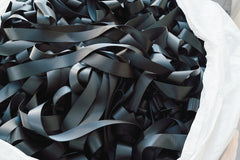
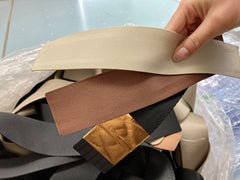
Various colors of belts are used depending on the car model.
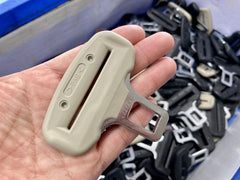
② Tongue
A tongue is a metal part of a seatbelt buckle.
We use tongues that have been scratched in the factory or used in crash tests.
They come in colors such as black and beige, depending on the car model.
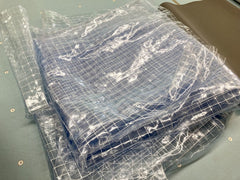
③ Vinyl curtain scraps
These are provided by "Team Like Inc.", a tent manufacturer located in Inuyama City, Aichi Prefecture.
When we were looking for manufacturers struggling with scrap disposal,
they sympathized with Think Scrap's concept and offered their cooperation.
Q. Where are they made?
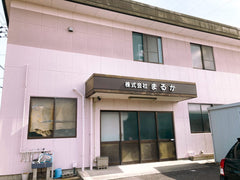
A. They are made at "Maruka Inc.", a sewing factory in Nishio City, Aichi Prefecture.
Seatbelt fabric is thick and stiff,
requiring sewing machines capable of handling this thickness.
Moreover, since each scrap material varies in size and condition,
cutting and sewing the fabric takes time and effort.
Maruka Inc. took on this challenging manufacturing process.
...
Please see the link below for more details.


